
An NPMA-33 inspection is a visual check for wood-destroying insects, recorded on a standard report. Your lender may require it for a VA or FHA loan, or when there are signs of an infestation. It can also be requested for a conventional loan. Ask your lender early whether you need the report, then hire an inspector authorized under your state’s rules.
The report shows what the inspector could see, what areas they could not reach, and whether treatment is recommended. It is not a guarantee that the home is free of hidden insects or damage. For a home purchase in the Washington, DC metro area, understanding that limit helps you plan any follow-up before closing.
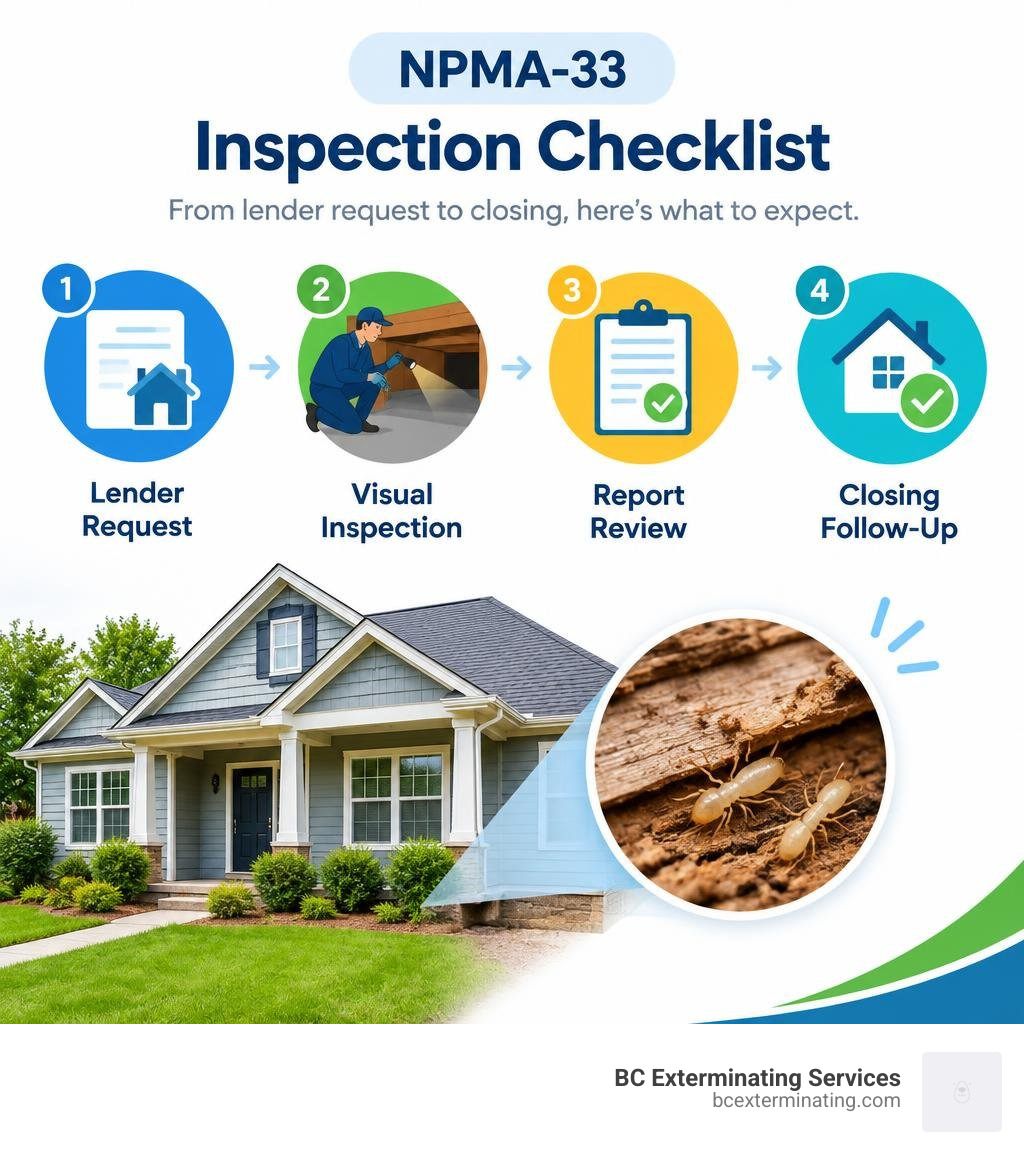
Purchasing a home represents one of the largest financial investments you will ever make. Hidden beneath fresh paint, beautiful hardwood floors, and updated drywall, structural timbers can harbor unwanted guests. In the United States, subterranean termites alone cause an estimated $5 billion in property damage every year—damage rarely covered by standard homeowners insurance policies.
To protect both lenders and buyers from catastrophic structural surprises, the National Pest Management Association (NPMA) developed the Wood-Destroying Insect (WDI) Inspection Report, designated officially as Form NPMA-33. This standardized legal form provides mortgage underwriters, appraisers, buyers, and sellers with an objective snapshot of a home’s wood-destroying insect activity at the time of inspection.
The federal government takes wood-destroying pests seriously. According to the HUD Wood Destroying Insect Inspection Report Notice, the NPMA-33 form is officially approved and mandated across HUD-insured housing transactions whenever a pest inspection is triggered.
Beyond checking a box for mortgage underwriting, an NPMA-33 report acts as a powerful risk-mitigation tool. It gives buyers clear negotiating power if active pests or prior untreated damage come to light. That timing is everything: an NPMA-33 inspection report remains valid for exactly 90 days from the date of inspection. If your closing timeline stretches beyond three months, underwriters will require an updated report.
Different loan programs carry distinct rules regarding when an NPMA-33 inspection is required:
A common point of confusion during real estate transactions involves the difference between the NPMA-33 inspection report and the HUD-NPMA-99 series forms. While all three deal with pest management, they serve different stages of a building’s lifecycle.
| Feature / Purpose | NPMA-33 (WDI Inspection Report) | HUD-NPMA-99A | HUD-NPMA-99B |
|---|---|---|---|
| Property Type | Existing construction (resale homes) | New construction (newly built homes) | New construction (newly built homes) |
| Primary Purpose | Visual assessment of active/past insect activity | Builder’s guarantee of subterranean termite protection | Pest control company record of applied soil/wood treatment |
| Who Completes It | Licensed commercial pest inspector | Home builder / general contractor | Licensed pest control operator |
| Regulatory Scope | HUD, VA, FHA, and conventional loan compliance | HUD/VA new construction compliance | HUD/VA new construction compliance |
| OMB Expiration | Revised version 7/01/19 (permanent standard) | Approved through 7-31-2027 | Approved through 7-31-2027 |
For new construction homes, lenders require builders to provide soil pre-treatment warranties using forms 99A and 99B. For existing residential structures, the standard WDI inspection relies exclusively on the NPMA-33 form. Further details regarding these forms can be found in the NPMA Forms Information portal.
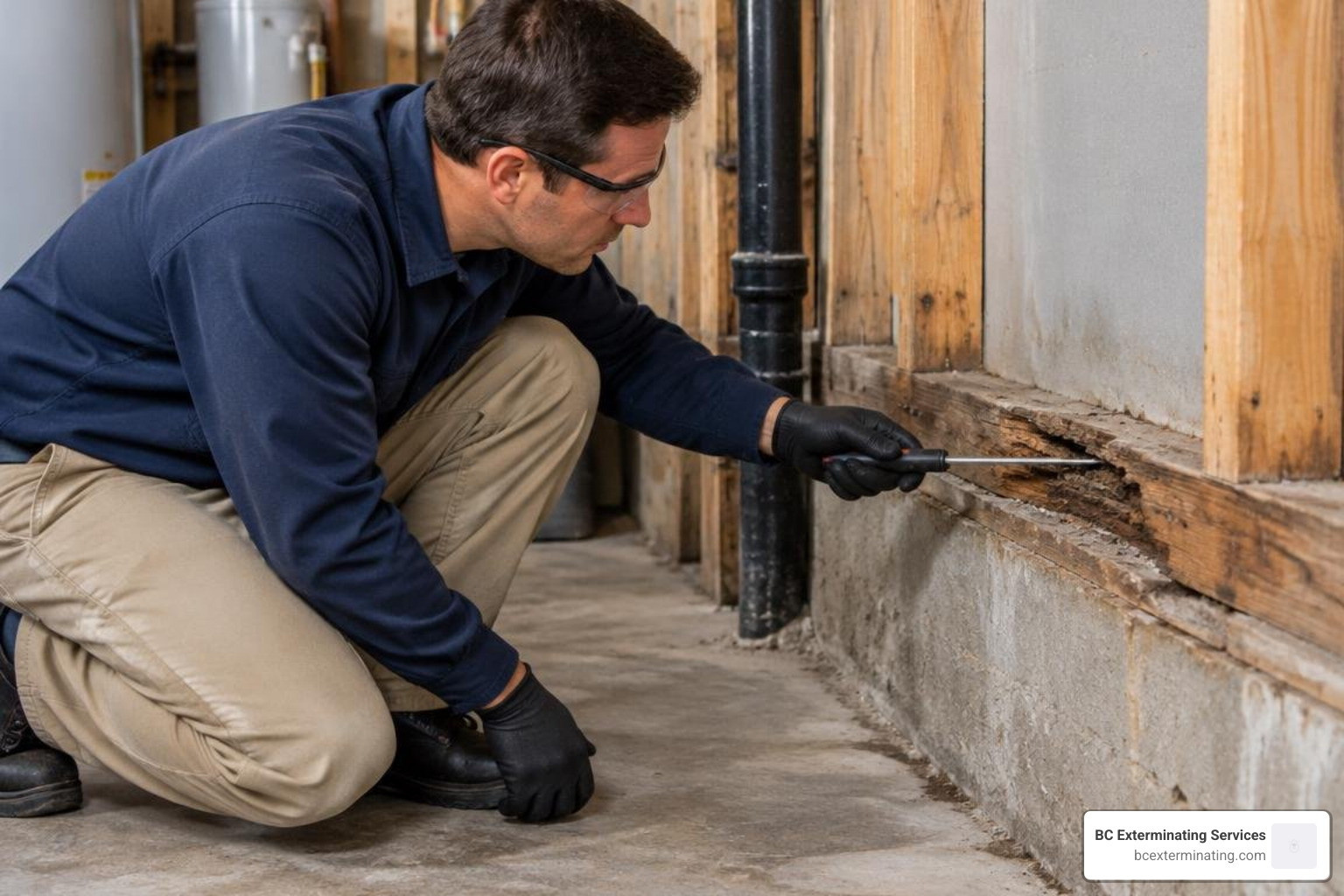
Understanding what an inspection covers—and what it deliberately excludes—prevents misunderstandings during escrow. An NPMA-33 inspection is strictly a visual assessment of readily accessible areas of the property on the day of the visit.
Inspectors use flashlights, sounding probes, and moisture meters to evaluate structural framing, sill plates, baseboards, crawlspaces, and exterior perimeters. However, inspectors cannot dismantle walls, pull up finished flooring, remove insulation, or move heavy furniture.
Crucially, an NPMA-33 report is not a structural damage warranty and does not guarantee that hidden pests do not exist behind sealed walls. Furthermore, the form explicitly excludes non-insect wood-destroying organisms. Mold, mildew, wood-decay fungi, dry rot, and moisture damage fall outside the scope of an NPMA-33 report unless they are directly associated with active wood-destroying insect infestations.
The NPMA-33 form is strictly limited to identifying evidence of specific wood-destroying insects:
One of the most important parts of the form is Section IV, where inspectors record inaccessible zones. If an inspector cannot reach a critical area, they must document the obstruction using standardized numerical codes.
Common obstructions include:
If significant areas of a home are marked as obstructed, underwriters may request a follow-up inspection once items are moved or access hatches are opened.
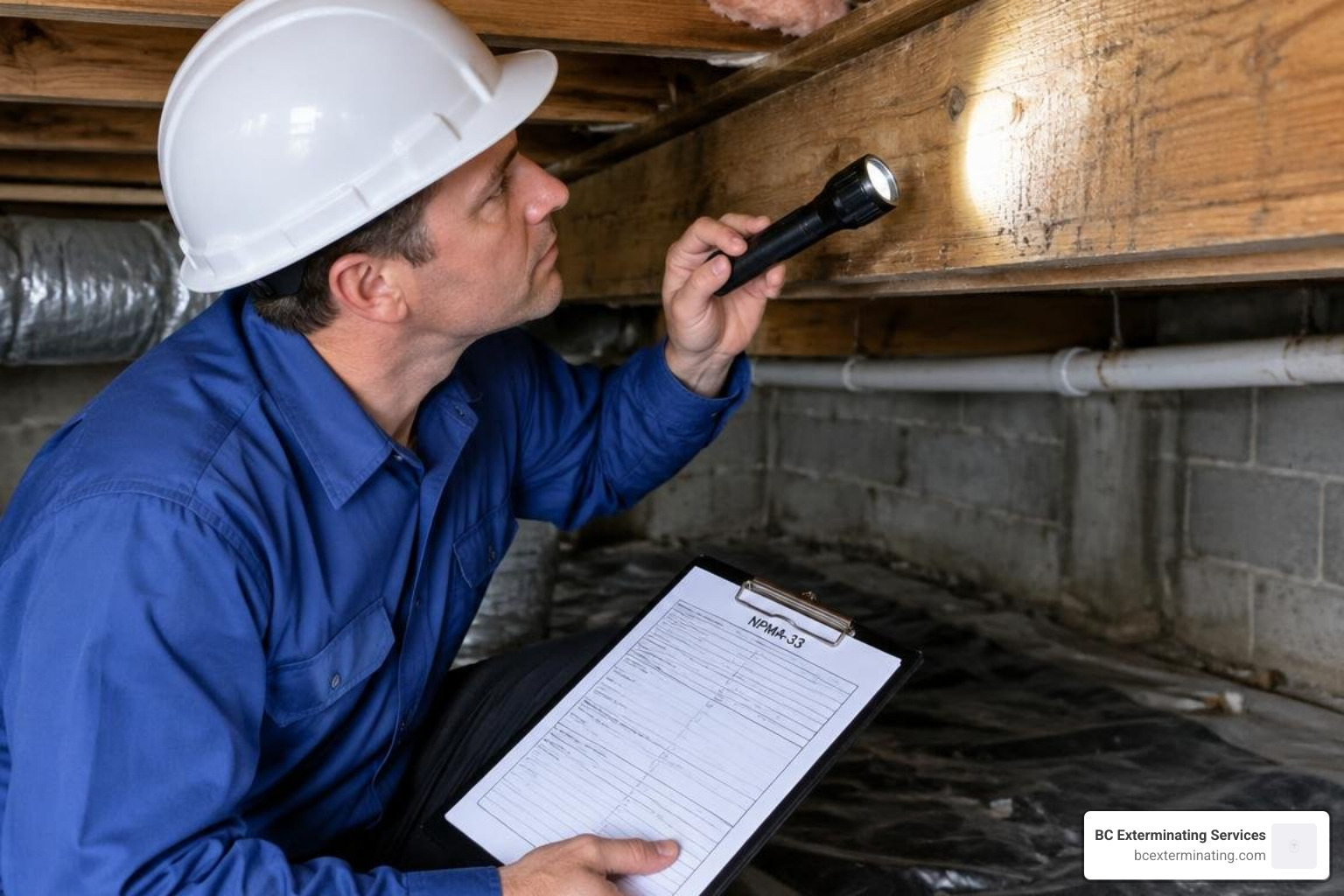
The current official version of the report is Form NPMA-33 (revised 7/01/19). All previous editions became obsolete as of December 31, 2019. When completing or reviewing this legal document, professionals follow the Suggested Guidelines for Completing the Revised NPMA-33 Form established by industry regulators.
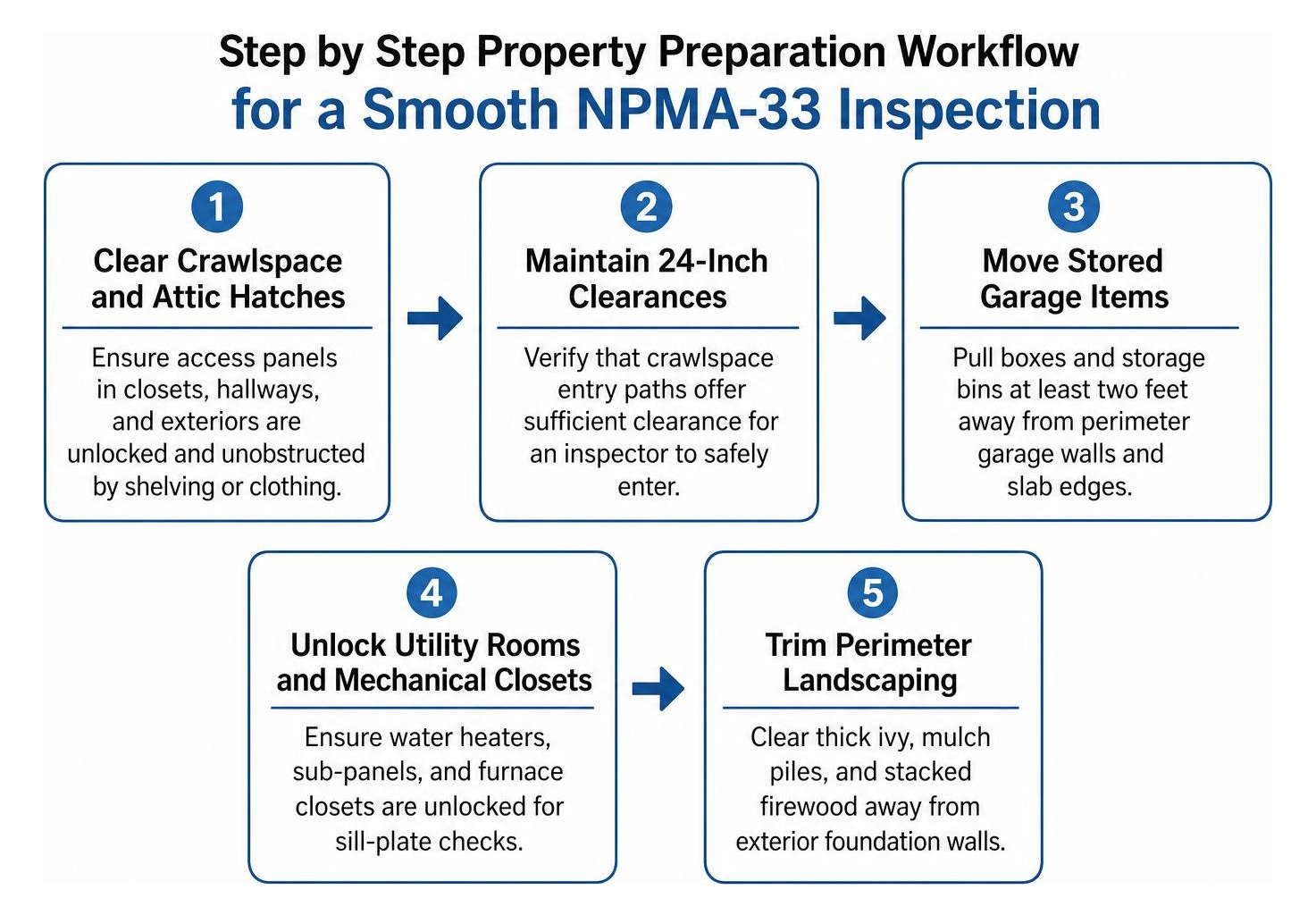
To ensure a smooth, unobstructed inspection that satisfies underwriters on the first try, sellers and buyers should coordinate access beforehand:
The NPMA-33 report consists of five distinct sections:
This section records administrative details, including the inspection company’s legal name, business address, telephone number, state pesticide business license number, inspector’s certification credentials, property address, and the specific structures inspected (e.g., main dwelling, detached garage, storage shed).
Section II contains the core findings of the visual assessment:
Section III outlines whether chemical or physical remediation is needed. If Box B is checked in Section II and there is no documented evidence of a professional treatment within the past five years, the inspector will check the box recommending professional treatment.
This section lists every area of the property that could not be visually examined, matched with specific numerical obstruction codes (e.g., code 1 for fixed ceilings, code 4 for insufficient crawlspace clearance).
Section V provides space for inspector notes, details about prior treatment stickers found in utility closets, and references to attached structural diagrams. It concludes with mandatory certification signatures from the inspector, followed by acknowledgement signatures from the property buyers and sellers at closing.
Finding insect activity on an NPMA-33 form is not the end of your home purchase. Instead, it triggers a clear set of remedial steps:
While the NPMA-33 form is national, individual states govern the licensing, execution, and legal liabilities surrounding real estate pest inspections. An inspection completed by an uncertified individual or one who fails to follow state-mandated timing rules will be rejected by mortgage underwriters.
State pesticide boards establish strict rules for completing real estate inspection reports:
In our service areas across Montgomery County and the greater Washington, DC metro area—including Gaithersburg, Rockville, Bethesda, Silver Spring, Germantown, and Potomac—inspectors must hold active commercial applicator credentials in their respective jurisdictions (such as Maryland and the District of Columbia). Our technicians adhere to these strict regional standards, providing thorough visual assessments paired with low-odor, environmentally conscious treatment options when needed.
An NPMA-33 inspection report is valid for 90 calendar days from the date the visual inspection was conducted. Mortgage underwriters will not accept a report that exceeds this 90-day window at settlement. If your closing is delayed due to financing or title issues, a licensed inspector must perform a re-inspection and issue a new report.
A general home inspector can only complete and sign an official NPMA-33 form if they hold a valid state commercial pesticide applicator license with the appropriate wood-destroying organism category endorsement. A standard home inspection license alone is not legally sufficient to issue an NPMA-33 report for FHA, VA, or HUD-backed mortgages.
No. A positive report documenting past insect damage or active pests does not cancel a transaction. It simply requires remediation. Typically, the buyer and seller negotiate who covers the cost of professional treatment and any necessary structural repairs. Once treatment is completed by a licensed pest control company and documented for the lender, the mortgage process moves forward to closing.
A home purchase represents both your family’s sanctuary and a significant financial investment. Navigating loan requirements, appraisals, and closing deadlines can feel overwhelming, but an NPMA-33 inspection provides essential clarity on your home’s structural health. By identifying hidden insect activity and past damage before settlement, you protect yourself from unexpected repair bills.
Whether you are buying a home in Bethesda, selling a property in Rockville, or closing on a house in Gaithersburg, our team is here to assist. At BC Exterminating Services, we utilize a thorough inspection-first process, pairing thorough visual reporting with pet-friendly, EPA-registered treatments to ensure your transaction proceeds smoothly. Schedule your professional real estate inspection with BC Exterminating Services today and step into your new home with complete peace of mind.