
Start with three steps: Set snap traps along walls where you see droppings, store food and pet food in sealed containers, and seal gaps as small as 1/4 inch around doors, pipes, and the foundation. Check traps daily and keep trapping while you close entry points. This removes mice already inside and helps stop new ones from getting in.
Act soon if you spot fresh droppings or hear scratching at night. Mice can multiply quickly, contaminate food, and damage wiring. Traps, cleanup, and solid repairs will do more than a plug-in repellent. The best way to get rid of a mouse in the house is to combine trapping, food removal, and structural exclusion into one consistent plan.

Before you can solve a rodent problem, you must know what species you are dealing with. Treating a mouse problem with rat-sized tactics—or vice versa—leads to missed catches, wasted bait, and lingering pests. Both animals are nocturnal, secretive, and capable of causing significant structural damage by chewing through wood, drywall, and electrical wiring. However, their behaviors, biology, and physical evidence differ dramatically.
Proper identification relies on examining physical evidence such as fecal pellets, gnaw patterns, rub marks along baseboards, and vocalizations. Understanding the house mouse and its habits will help you choose the right control plan from day one.
| Trait | House Mouse (Mus musculus) | Norway Rat / Roof Rat (Rattus spp.) |
|---|---|---|
| Adult Body Weight | ~0.5 ounce (15 grams) | 7 to 18 ounces (200–500 grams) |
| Total Length | 5.5 to 7.5 inches (including tail) | 13 to 18 inches (including tail) |
| Dropping Shape & Size | Pointed ends, ~1/4 inch (6 mm) long | Blunt or pointed ends, 1/2 to 3/4 inch (13–20 mm) |
| Ears & Head | Large ears, pointed small snout | Smaller ears relative to head, blunt or slender snout |
| Tail Appearance | Semi-naked, slender, as long as body | Heavy, scaly, often shorter than body (Norway) or longer (Roof) |
| Daily Feeding Habit | Nibbles constantly; ~200 micro-meals nightly | Eats larger meals at fixed feeding stations |
| Territory Range | 10 to 30 feet from the nest | 100 to 300 feet from the burrow/nest |
House mice leave clear, unmistakable signs:
Homeowners often mistake a young rat for an adult house mouse. Look at the feet and head: juvenile rats have disproportionately large hind feet, thick tails, and heavy heads compared to their bodies. A mature house mouse has delicate, small feet, large rounded ears, and a thin tail matching or exceeding its body length.
Behavior also differs significantly. Mice are naturally curious (neophilic), investigating new objects—like traps—within hours. Rats are deeply suspicious (neophobic) and may avoid a newly placed trap for days.
Tracking footprints is an easy way to verify activity. Lightly dust suspected pathways with talcum powder or mason’s chalk; the next morning, examine the distinct four-toed front and five-toed hind tracks to gauge their size and travel frequency.
Relying on a single trap or an aerosol spray rarely eliminates a mouse problem. Mice breed rapidly, with females producing 5 to 10 litters per year of 5 to 6 pups each. A lasting solution requires an Integrated Pest Management (IPM) framework that eliminates entry points, cuts off resources, and rapidly removes existing populations.
Applying house mouse IPM management principles gives you a systematic, repeatable way to clear rodents without unnecessary pesticides.
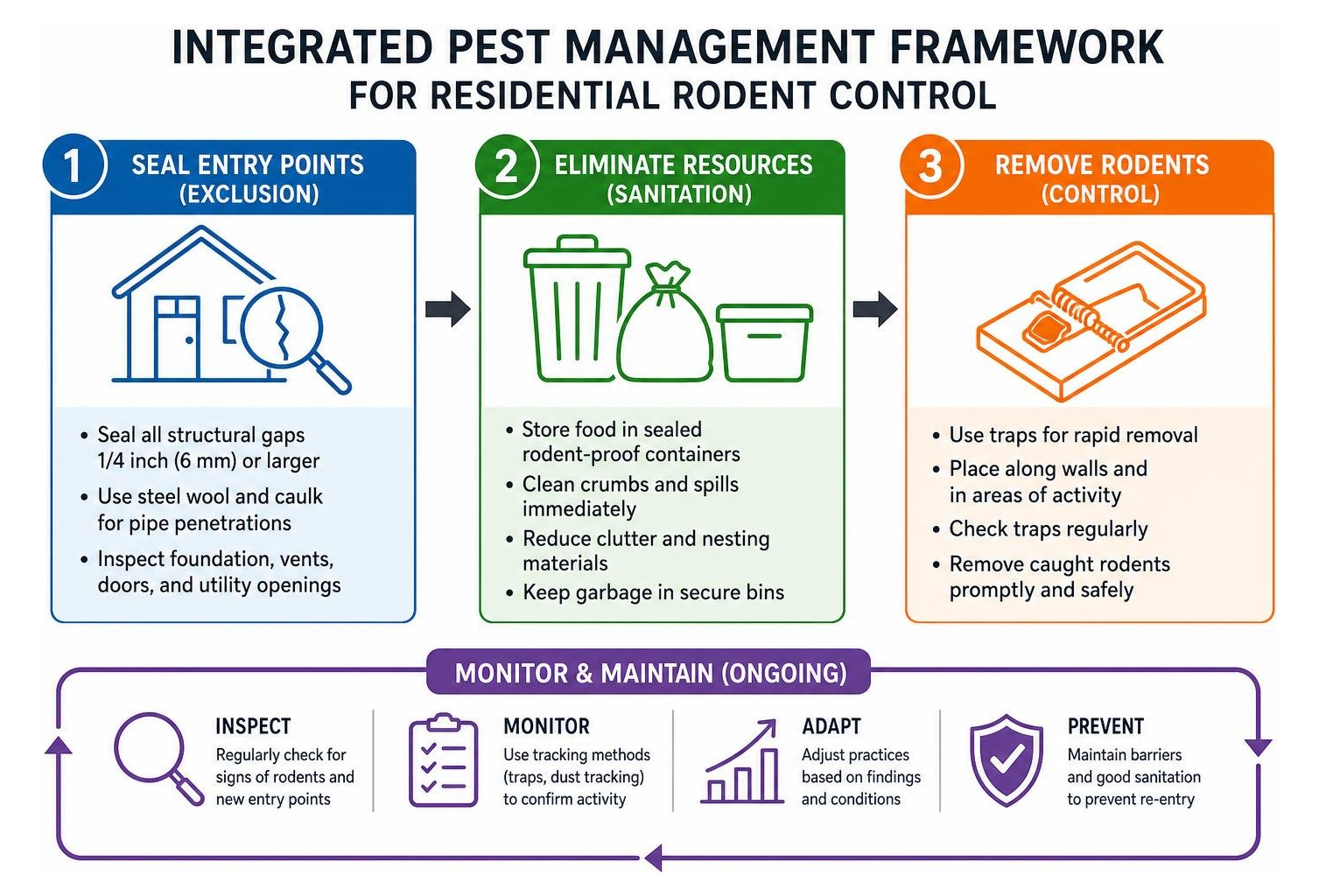
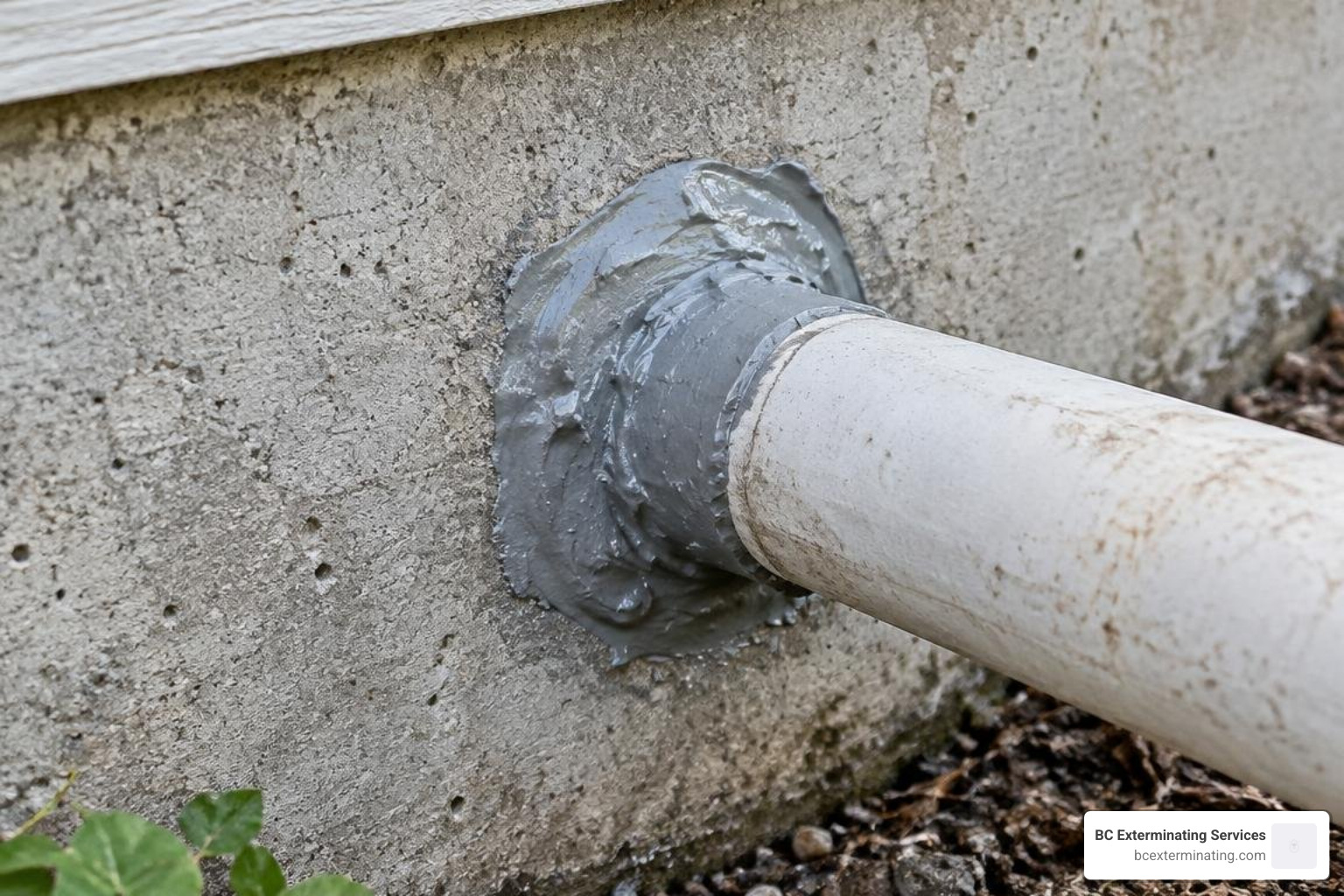
Exclusion is the foundation of long-term mouse control. An adult house mouse can compress its skeleton and slip through an opening as small as 1/4 inch (6 mm)—roughly the diameter of a standard pencil or a dime.
Mice enter homes in search of steady food and shelter. An adult mouse requires only 3 to 4 grams of food daily, eating in up to 200 tiny nibbling sessions every night. Removing their food sources forces them to seek out your baited traps.
Once you have sealed entry points and eliminated accessible food, set a dense grid of traps to catch the mice trapped inside.
Choosing the right trap and bait ensures fast, humane removal. Different trap styles suit different preferences, whether you prefer traditional snap mechanisms, electronic traps, or catch-and-release models.
Reviewing regional guidelines for managing rat and mouse pests highlights the importance of matching trap mechanics to rodent behavior.
| Trap Type | Mechanism | Primary Advantages | Considerations & Drawbacks |
|---|---|---|---|
| Expanded-Trigger Snap Trap | High-tension spring bar with wide plastic pedal | Inexpensive, highly reliable, delivers immediate lethal impact | Must be handled carefully during setting; requires manual carcass removal |
| Electronic Electrocution Trap | High-voltage internal metal plates | Enclosed kill chamber, no-touch disposal, clean and fast | Requires batteries; higher upfront cost; indoor use only |
| Multiple-Catch Live Trap | One-way mechanical ramp/gravity door | Captures multiple mice alive; no poisons or snapping parts | Requires frequent checking (every 12–24 hrs); requires humane release protocol |
| Single-Catch Humane Cage | Spring-trip wire gate | Pet-safe, transparent inspection, allows live release | Catches only one mouse at a time; must be inspected daily |
For standard residential use, modern expanded-trigger plastic snap traps (such as the Bell Trapper Mini Rex or Victor Quick-Set) offer the most reliable results. Their wide trip pedals trigger easily whether a mouse approaches from the left, right, or front.
If you prefer non-lethal methods, explore humane non-poison mouse control techniques using multi-catch live traps (such as the Victor Tin Cat). Live traps must be checked at least every 12 to 24 hours. Leaving a trapped mouse longer causes severe dehydration, distress, and hypothermia.
Release captured mice at least one to two miles away from your home, near an exterior outbuilding or dense brush cover, to prevent them from returning.
Note on Glue Boards: We do not recommend glue boards. They are inhumane, causing prolonged distress, and do not provide the clean, instant kill of a properly set snap trap or electronic unit.
Forget the old cartoon myth of using yellow cheese. Mice are granivores and seed-eaters by nature; they strongly prefer calorie-dense, high-protein, and high-fat foods.
Many homeowners turn to quick DIY home remedies that promise easy results without hands-on trapping. Unfortunately, the vast majority of these methods fail to resolve infestations and often create new hazards.
Before testing unverified repellents, read through reliable research evaluating humane no-kill methods to see why exclusion consistently outperforms scent-based and acoustic options.
Using rodenticide poison blocks inside living spaces often creates more problems than it solves:
Mice carry pathogens that can contaminate household surfaces, including Salmonella, Lymphocytic Choriomeningitis Virus (LCMV), and Leptospirosis. In areas where wild deer mice (Peromyscus maniculatus) are present, their dried urine and feces can harbor Hantavirus Pulmonary Syndrome—a severe respiratory illness spread by inhaling airborne particles.
Follow these strict cleaning steps to sanitize affected areas safely.
While small mouse problems can often be managed with DIY steps, extensive infestations require specialized equipment and expertise. Consider calling a licensed professional if:
For homeowners in the Washington, DC metro area (including Gaithersburg, MD), our team at BC Exterminating Services provides complete rodent inspections, clean structural exclusion, and pet-friendly treatments to solve mouse problems at the source.
Mice reproduce quickly. A single female house mouse can produce 5 to 10 litters per year, averaging 5 to 6 pups per litter. Young mice reach sexual maturity in just 6 to 8 weeks. Left unmanaged, a single breeding pair can quickly multiply into dozens of mice within a few months, making early trapping and exclusion essential.
No. Independent scientific testing shows that ultrasonic devices do not clear established mouse infestations. High-frequency sound waves cannot pass through walls, solid cabinets, or furniture, and mice quickly grow used to the noise in open areas. Sealing entry points and setting physical traps remains the most reliable method.
High-protein, calorie-dense foods work best. Smooth peanut butter, hazelnut spread, and sunflower butter are top choices because mice cannot easily pull them off the trap trigger without setting it off. A tiny pea-sized drop is all you need to draw mice onto the pedal.
Clearing mice from your home doesn’t have to be a long, frustrating struggle. Lasting control comes down to a clear, three-part plan: seal every exterior gap down to 1/4 inch with steel wool and caulk, lock away all food and pet kibble in airtight containers, and place a dense line of snap traps along active baseboards. Skip unproven plug-in repellents and indoor poisons, and stick with reliable, practical steps.
If you are dealing with a tough infestation behind walls or need help sealing up complex rooflines and foundations, reach out to our team for professional pest and rodent exclusion services. With careful exclusion, proper cleanup, and steady trapping, you can protect your home and keep it completely rodent-free.